
How to Build a SaaS Product Roadmap in 2026 (That Actually Works)
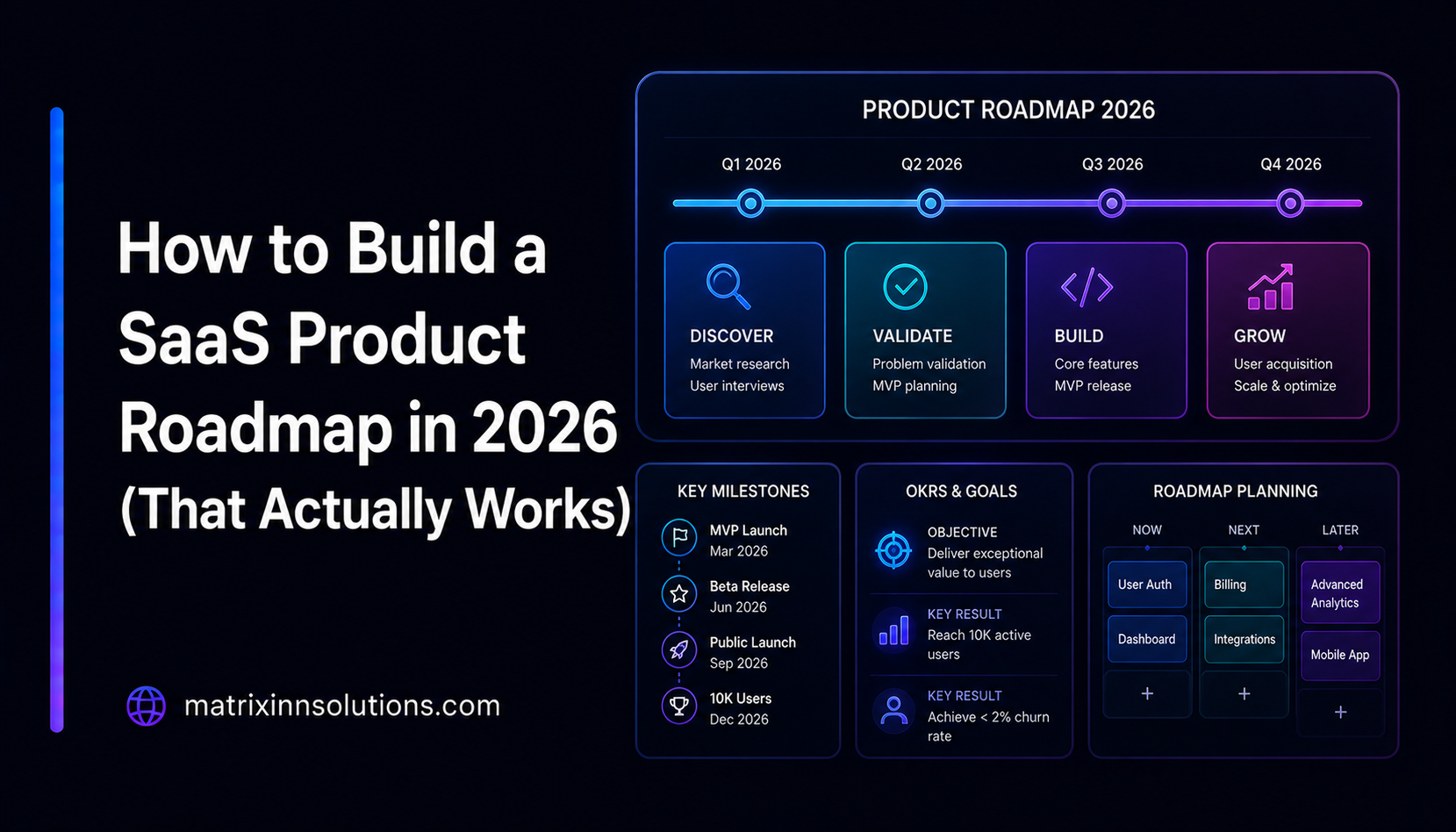
A product roadmap is one of the most powerful — and most misused — tools in a SaaS company's arsenal. When done right, it aligns engineering, sales, customer success, and marketing around a shared vision and drives decisions that compound over time. When done wrong, it becomes a political document full of features no one really needs, commitments you can't keep, and priorities that change every sprint.
Here's how to build a SaaS product roadmap in 2026 that your team will actually follow.
What a Product Roadmap Is (and Isn't)
A product roadmap is a high-level plan that communicates direction and priorities over time. It answers: where are we going, what are we building next, and why?
It is not:
- A feature backlog (that's Jira)
- A commitment to specific release dates
- A list of everything customers have ever requested
- A document that stays static for 12 months
The most common roadmap failure mode: treating it as a contract. Roadmaps should be living documents that change as you learn. If your roadmap hasn't changed in 6 months, either your market is unusually predictable or you're not learning fast enough.
Start With Strategy, Not Features
Before you prioritize a single feature, you need to answer three questions:
- What is the goal for the next 6–12 months? Reduce churn? Expand to a new segment? Improve NPS from 30 to 50? Double revenue?
- Who is our primary customer? Not everyone. The customer whose needs you're most optimizing for in this phase.
- What is the one metric that matters most? MRR, DAU, activation rate, NPS? Pick one and let it guide prioritization.
These answers become your "product strategy north star." Every item on the roadmap should be traceable back to one of these goals. If you can't explain how a feature moves the needle on your core metric, it probably doesn't belong on the roadmap.
Choosing a Prioritization Framework
RICE Framework
RICE scores each idea on four dimensions:
- Reach: How many users affected per month?
- Impact: How much does it move the needle? (1=minimal, 2=low, 3=medium, 5=high, 10=massive)
- Confidence: How confident are we in the estimates? (as a %)
- Effort: How many person-weeks?
RICE Score = (Reach × Impact × Confidence) / Effort
Higher score = higher priority. It sounds clinical, but it forces honest conversations about assumptions and trade-offs.
Impact vs Effort Matrix
A 2×2 matrix with Impact on one axis and Effort on the other. Quadrants:
- High impact, low effort → Do immediately ("quick wins")
- High impact, high effort → Plan carefully ("major projects")
- Low impact, low effort → Fill sprint capacity ("fill-ins")
- Low impact, high effort → Don't do it ("time sinks")
Simple, fast to apply, great for quarterly planning sessions with cross-functional teams.
Jobs to Be Done (JTBD)
Frame every feature as a "job" the customer is trying to get done: "When I [situation], I want to [motivation], so I can [expected outcome]." This prevents building features that sound good in theory but don't match real customer needs.
Gathering Customer Input Without Building the Wrong Thing
Customer feedback is essential but treacherous. Customers are excellent at describing problems and terrible at prescribing solutions. When a customer says "I need a bulk import feature," the real job-to-be-done might be "I need to get started faster." The solution might be better onboarding, not bulk import.
Better feedback channels for 2026:
- User interviews (weekly or biweekly) — 30-minute calls with churned customers, active power users, and trial-to-paid conversions. Ask about problems, not features.
- In-app surveys (Survicate, Sprig) — Trigger surveys at key moments (after task completion, on cancellation intent)
- Session recording (Hotjar, FullStory, PostHog) — Watch how users actually use your product. The gap between what people say and what they do is revealing.
- Feature request voting (Canny, Productboard) — Collect and prioritize requests, but weight by customer MRR, not just vote count
- Churn interviews — Mandatory. Talk to every churned customer you can reach. Their reason for leaving is often your most actionable roadmap input.
Structuring Your Roadmap
The Now / Next / Later Framework
Avoid quarterly or yearly dates in roadmaps. They become commitments you'll fail. Use time horizons instead:
- Now (this sprint or month): Specific, well-defined. Committed to.
- Next (next 1–3 months): Directional. Scope may change as you learn.
- Later (3–12 months): Strategic themes. No specific features.
Themes, Not Features
The best roadmaps communicate themes and outcomes rather than specific features. Instead of "Add bulk CSV import," the roadmap says "Reduce time-to-value for new teams." The feature is an implementation detail. The outcome is the commitment.
This gives engineering flexibility, avoids scope creep from premature specificity, and focuses everyone on why something matters.
OKRs and Roadmaps
OKRs (Objectives and Key Results) are the best way to connect roadmap items to business outcomes:
- Objective: Improve new user activation
- KR1: Increase % of users completing core action within 24 hours from 35% to 55%
- KR2: Reduce median time-to-first-value from 3 days to 8 hours
Every roadmap item in a given quarter should map to an OKR. If it doesn't, ask why it's being built.
Communicating Your Roadmap
Internal vs External Roadmaps
Keep two versions:
- Internal (detailed): For engineering and product. Includes priorities, dependencies, effort estimates, and owner assignments.
- External (high-level): For customers and prospects. Shows themes and direction. Never specific dates or features you're not committed to.
Sharing your external roadmap builds trust with customers and prospects. A public roadmap (Trello, Canny, Productboard public view) can also be a sales tool — showing the direction you're heading.
Stakeholder Communication
- Engineering: Sprint planning (weekly) + quarterly roadmap review
- Sales: Monthly roadmap review so they can set accurate expectations with prospects
- Customer Success: Weekly standup on releases that affect active customers
- Executives: Quarterly roadmap review tied to OKR progress
Roadmap Tools (2026)
- Linear — Best for developer-centric teams. Clean, fast, excellent GitHub integration.
- Productboard — Best for PM-centric teams with strong customer feedback integration.
- Canny — Best for customer-facing public roadmaps and feature voting.
- Notion — Best for early-stage startups. Free, flexible, easy to share.
- Jira + Roadmaps — Best for enterprises already using Jira.
Common Roadmap Mistakes
- Over-committing to dates — Roadmaps are not release plans. Leave buffer.
- Feature-level thinking — Plan outcomes, not features.
- Ignoring technical debt — Allocate 20–30% of engineering capacity to infrastructure and debt repayment, or velocity will decline over time.
- Not reviewing quarterly — Markets change. Revisit and revise at least every 3 months.
- Roadmap theater — Building what looks impressive on the roadmap vs. what moves the metrics. Optimize for outcomes, not optics.
The Bottom Line
A great product roadmap is a communication tool, a prioritization system, and a strategic compass — all in one. It's not a feature list and not a contract. Build it around customer problems and business outcomes, keep it current, and use it as the single source of truth for what you're building and why.
Building a SaaS product and need help with architecture, development, or growth strategy? Talk to our team — we build SaaS products and can help with architecture and development.