
How to Build a SaaS MVP in 2026 Without Burning Your Budget
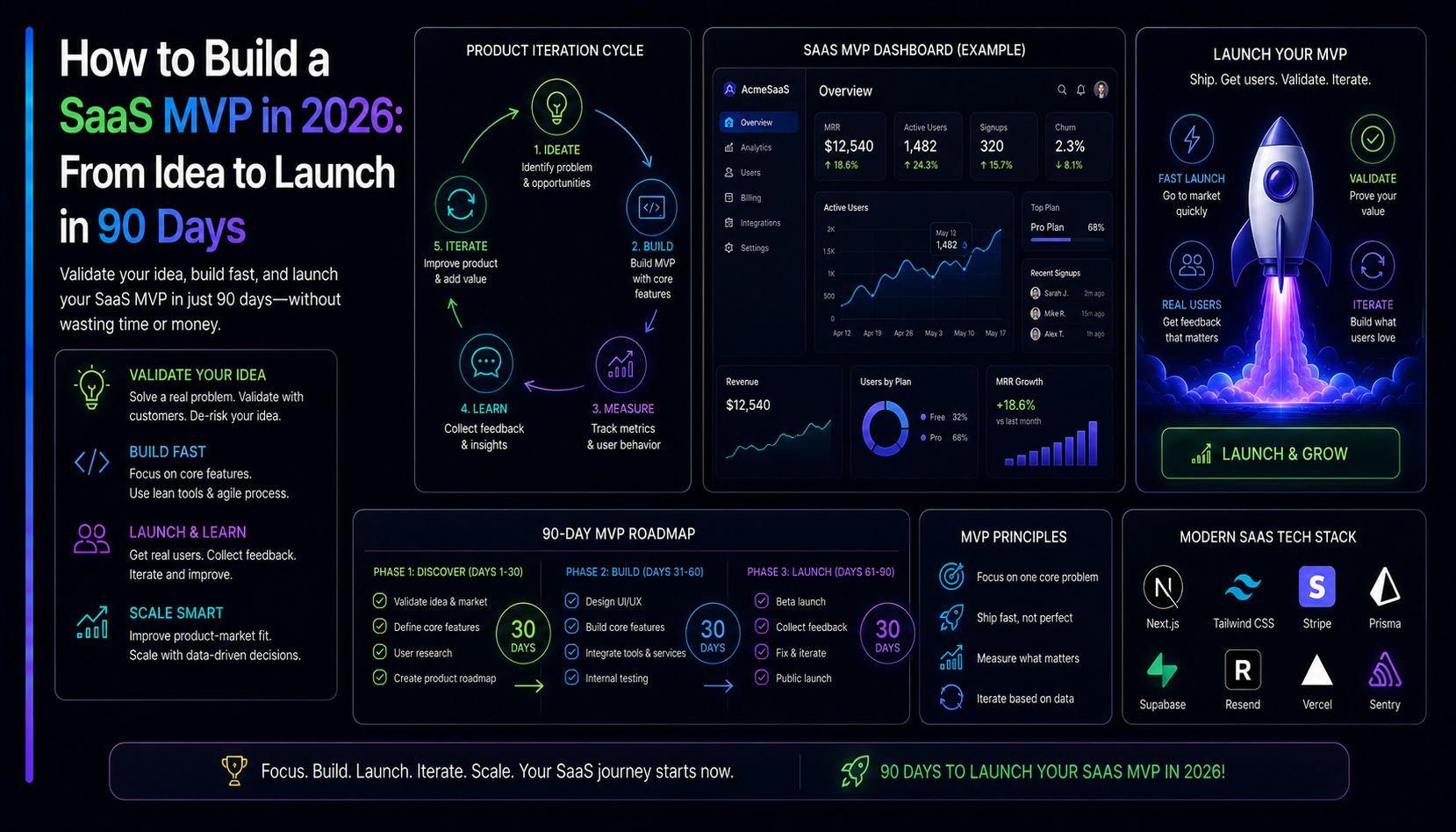
Most SaaS products that fail do not fail because of bad engineering. They fail because the team built the wrong thing — a full-featured version one that nobody asked for, shipped six months after they could have learned whether the core idea had legs. An MVP is not a buggy, half-finished product. It is the smallest, cleanest, most focused version of your product that lets you answer the real question: will real people pay money for this? Here is how to build one in 2026 without burning your runway on the wrong scope.
What MVP actually means — and what it does not
Minimum Viable Product is the most misused phrase in software. "Minimum" does not mean broken, ugly, or embarrassing. It means you have cut everything that does not help validate your core hypothesis. "Viable" means it works well enough that real users can judge whether they want it. "Product" means it is in production and being used by real people, not sitting in a slide deck or a private staging environment.
The question an MVP answers is: "does this solve a real problem that real people will pay money to solve?" Everything that does not help you answer that question belongs in version two.
Five questions to answer before you build anything
1. What is the one thing it does?
Every successful SaaS product does one thing well before it does ten things adequately. What is the single core action your product enables? Write it in one sentence. If you cannot, you do not have a specification yet — you have a collection of feature ideas.
2. Who is the first customer?
Not a market segment — a specific type of person or company. What job do they have? What tool do they use today to do the thing your product would do? Why is that tool insufficient? The more specifically you can describe the first customer, the better the MVP will serve them.
3. What does working look like on day one?
Map the user journey for your first customer in five steps. If you cannot walk through the product in five steps, you have too much scope in the MVP. The day-one user journey is the MVP scope — start there and trim anything that is not on that critical path.
4. What are you explicitly not building?
Write the cut list: features you know you will need eventually but are not building now. Team collaboration. Admin dashboards. Advanced reporting. API access for developers. Billing tiers. Integrations with other tools. Every item on this list is budget you are preserving for when the core is validated and you know what to invest in next.
5. How will you know it is working?
Before you build, define success. A retention rate. An activation rate. A number of paying customers. A revenue figure at week eight. Build the minimum analytics required to measure it — you cannot make good product decisions without data, and you cannot add tracking retroactively without missing the first-cohort signal.
What belongs in a SaaS MVP
- Authentication. Sign up, log in, password reset. Use a managed auth service — Clerk, Supabase Auth, or Auth0. Do not build authentication from scratch.
- The core feature. The one thing you wrote in one sentence above. Fully functional, not mocked. Real users need to be able to complete the actual workflow.
- Billing. Stripe Checkout or Lemon Squeezy for a simple subscription. You need to validate willingness to pay with a real payment, not just interest signals.
- Basic onboarding. Enough that a new user can complete the day-one journey without contacting support. A welcome email and a single in-app prompt is often enough.
- Error handling and logging. Real users will hit edge cases you did not anticipate. Log errors, handle them gracefully, and have visibility into what is breaking before your users tell you.
What does not belong in a SaaS MVP
- Multi-seat and team features
- Internal admin dashboards and operational tooling
- Advanced analytics and custom reporting
- A developer API and webhooks
- Mobile apps (unless your core use case is genuinely mobile-first)
- Third-party integrations beyond what the core feature requires
- Multiple pricing tiers (start with one price)
- A marketing site with more than five pages
The features that do not make it into the MVP are not failures — they are the roadmap. You learn whether to build them, and in what order, from what your first users actually do with the product.
Tech stack for a SaaS MVP in 2026
The right stack is the one your team can ship fastest without incurring technical debt that makes version two painful. The current consensus choices for most SaaS MVPs are:
- Frontend: Next.js (React) — server rendering, file-based routing, and a mature ecosystem that handles most SaaS UI patterns out of the box.
- Backend and database: Supabase — managed Postgres with authentication, storage, and real-time subscriptions built in. Eliminates weeks of backend infrastructure work for an MVP.
- Auth: Clerk or Supabase Auth — do not build auth from scratch. It is a commodity and it has security edge cases that managed services handle for you.
- Billing: Stripe — the industry standard. Lemon Squeezy is a good alternative if you want simpler global tax handling without a separate tax service.
- Hosting: Vercel for the frontend; the managed database service for the backend. Serverless is the right default for an MVP — scale when you have users, not before.
This stack lets a small team ship a working product in weeks, not months, and handles scaling gracefully when growth requires it.
Realistic cost and timeline
Simple MVP — 6 to 10 weeks
One core workflow, user accounts, a basic subscription, clean UI across the happy path. The right scope for validating whether the idea has commercial traction. Goal: live in production with real paying users as fast as possible. Everything else is noise until you have that first retention signal.
Mid-range MVP with integrations — 10 to 16 weeks
One to two core features with deeper onboarding, third-party integrations that are essential to the value proposition (a CRM sync, a data import, a Zapier connector), and a more polished UI. Still scoped tightly around the validation question — just more to build and test before you can answer it.
The mistakes that blow the budget
- Building a general solution when a specific one will do. "We might want to support any workflow" is the enemy of MVP scope. Build for one specific workflow perfectly.
- Building infrastructure that is a commodity. Auth, billing, email delivery, file storage — there are excellent managed services for all of these. Use them and spend your engineering budget on the unique parts of your product.
- Designing for scale before you have users. You do not need microservices, event-driven architecture, or a Kubernetes cluster for 100 users. Optimize for shipping speed, not hypothetical scale.
- Changing the spec mid-build. Spec changes during development typically cost far more than making the right decision before coding started. Freeze the scope, ship, learn, then change based on evidence.
After the MVP: when to scale
The signal to start building version two is not a time threshold — it is a retention signal. If users come back week after week, and they tell you clearly what they wish the product could do, that is when you invest in the next layer. Build until you have that signal, then build what the signal tells you to build — not what the roadmap said before you had users. You can read about how we approach SaaS work on our SaaS development services page.